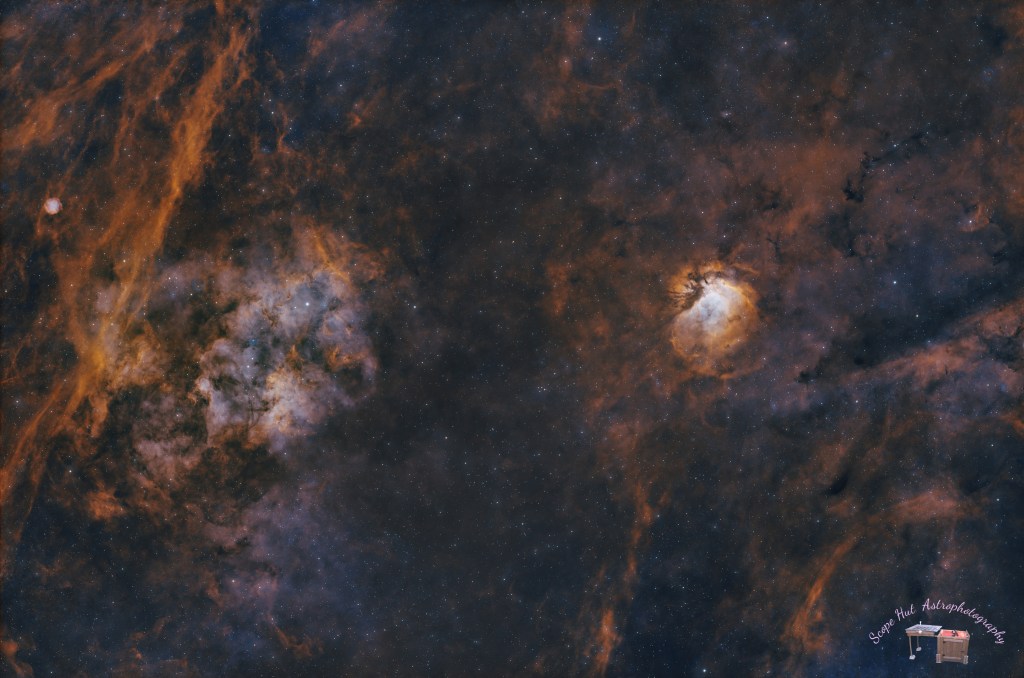
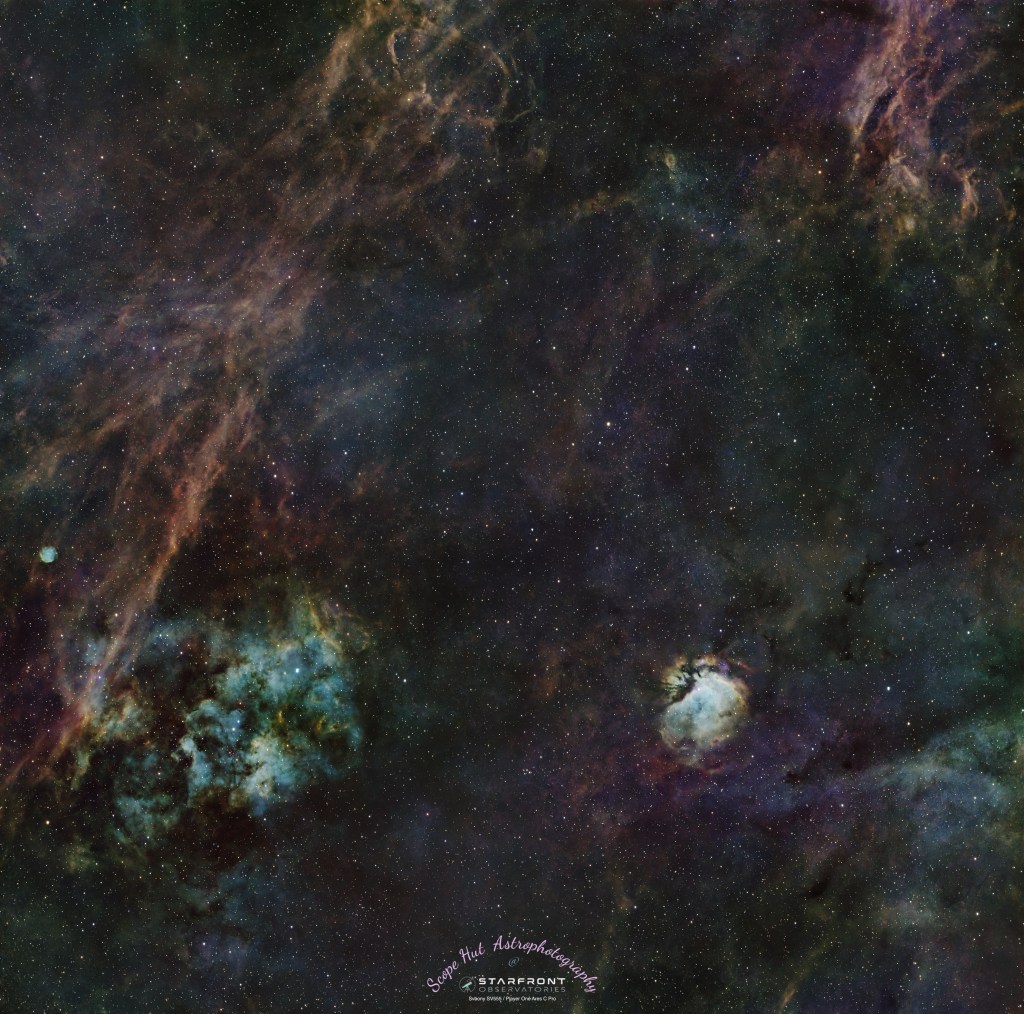
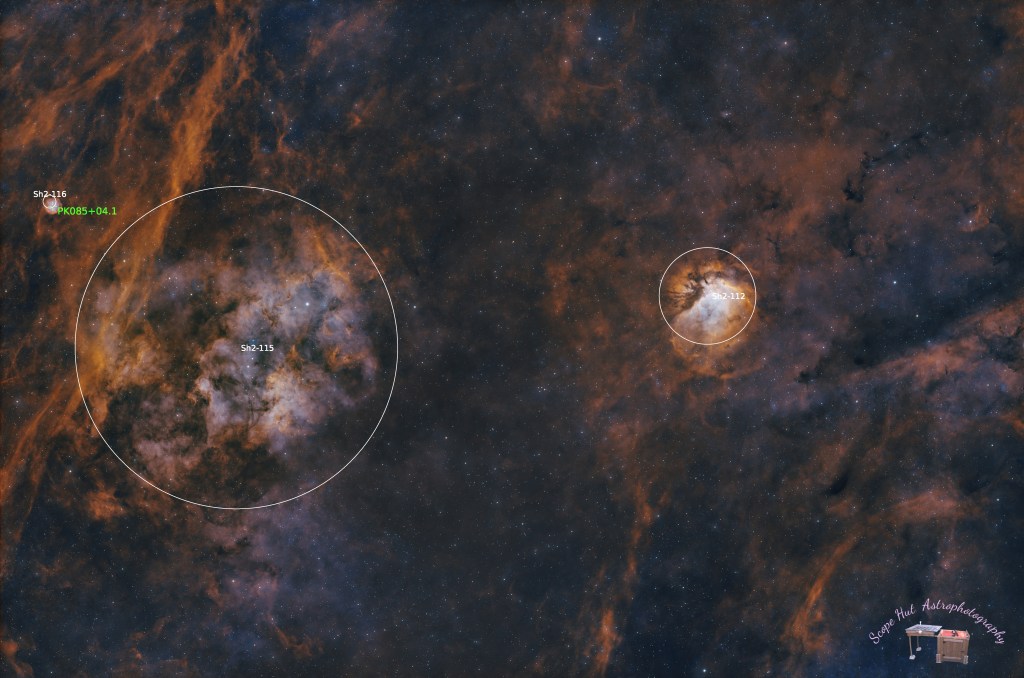
SH2-116 (also known as Abell 71) is a small round nebula in Cygnus, located near the bright star Deneb and adjacent to the larger emission region SH2-115.
• Originally classified as a planetary nebula due to its morphology, SH2-116 is now recognized as a small HII region—a localized area of ionized hydrogen.
• The nebula is listed in multiple catalogs: Abell 71, DWB 118, PK 085+04.1, and PN G084.9+04.4.
• SH2-116 appears as a distinct, circular patch of emission beside the broader SH2-115 complex. It sits within the structural boundaries of SH2-115 and is best captured with narrowband imaging, particularly using H-alpha, due to its faint response with standard RGB filters.
SH2-115 is a large, faint emission nebula situated in the constellation Cygnus, approximately 2° northwest of the bright star Deneb. Catalogued by Stewart Sharpless in 1959, this nebula marks the edge of one of the outer Milky Way’s giant molecular clouds and is a prominent structure in deep-sky astrophotography.
Physical Characteristics
• Type: HII region/emission nebula
• Distance: ~7,500 light-years from Earth
• Apparent size: About 100 × 70 arcminutes (wide-field framing recommended)
• Location: RA/Dec center ~ 308.3°, +47°10’ (J2000)
• Associated cluster: Host to young, hot stars in Berkeley 90, which power the nebula’s glow. This open cluster is likely only ~100 million years old and still partially embedded within SH2-115.
• Nearby objects: SH2-116/Abell 71 (just north and east), previously classified as a planetary nebula, now recognized as a small patch of HII emission.
SH2-112 (Sharpless 112, also known as LBN 337, DWB 174, Cederblad 181) is a diffuse emission nebula located in the constellation Cygnus, about 1–1.5° west-northwest of Deneb. It’s less commonly imaged but offers rewarding structure for dedicated astrophotographers.
Physical Characteristics
• Type: HII region / emission nebula
• Distance: 5,500–6,000 light-years
• Apparent size: ~15–18 arcminutes; about half the angular size of the full Moon
• Location: RA ~ 20h 34m; Dec +45° 43′
• Excitation Source: The O8V double star BD+45 3216, magnitude ~9.2, 30× brighter than the Sun
• Morphology: Round/circular nebula with prominent dark dust lanes on its western side, within a larger, fainter molecular gas complex
• Environment: Part of the Orion Arm, near the Cygnus X molecular cloud; neighboring SH2-115
Acquisition details: https://app.lightbucket.co/astronomers/scopehut/targets/f1cad879-1bf6-41a1-bbfc-beec27722d42
 ScopeHut Observatory
You must be logged in to post a comment.