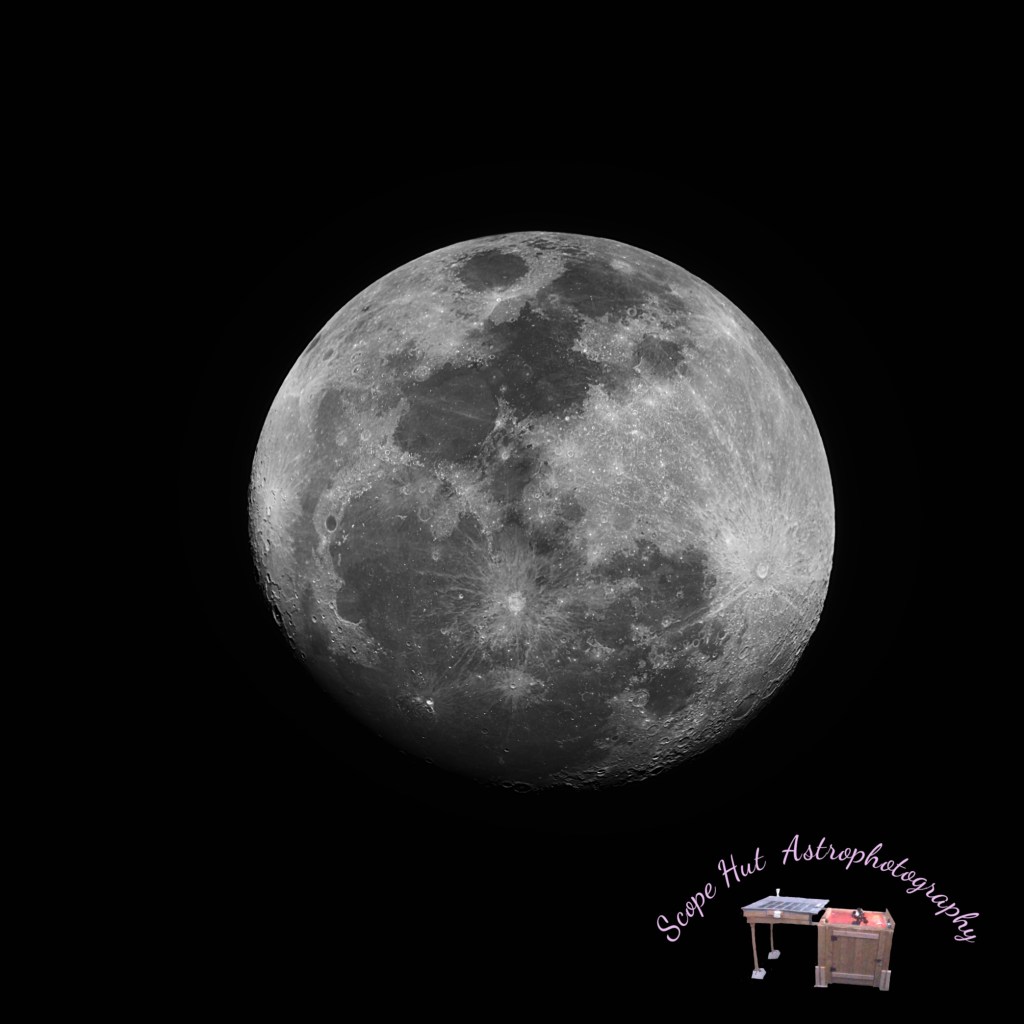
The Moon is Earth’s only natural satellite, measuring about 3,476 km in diameter—roughly one-quarter the size of Earth—and orbiting at an average distance of 384,400 km.
• Mass: 7.35 × 10²² kg (about 1/81 the mass of Earth).
• Surface gravity: One-sixth of Earth’s (0.1654 g)—allows astronauts to bounce easily on its surface.
• Orbital period: About 27.3 days to orbit Earth; it is tidally locked, so the same side always faces us.
• Structure: Composed of a small, dense iron-rich core (~240 km radius), rocky mantle, and a crust averaging 25–50 km thick.
• Surface: Covered in craters, dark basaltic plains called maria, and brighter highlands; features mountains, valleys, and the largest lunar basin (South Pole–Aitken basin).
• Atmosphere: Very thin, almost nonexistent—no weather, rain, or wind; extreme temperature swings.
• Temperature: Surface temperatures range from about 127°C in sunlight to -173°C in darkness.
 ScopeHut Observatory