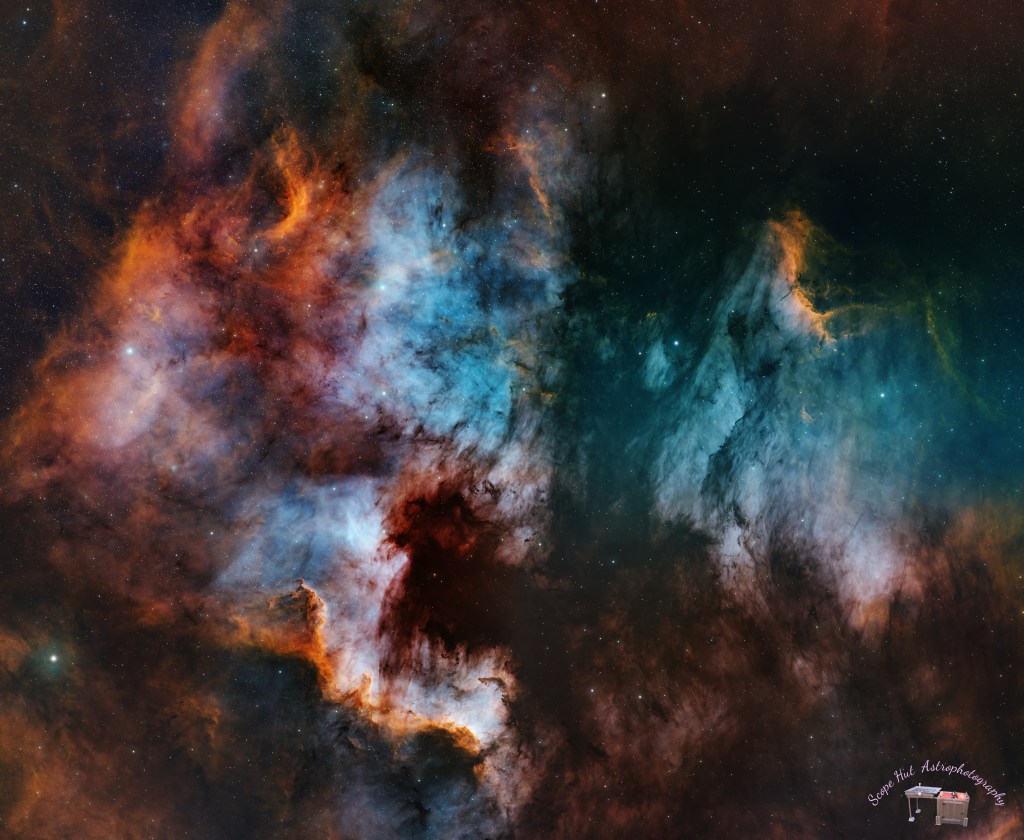
The North America Nebula (NGC 7000) and the Pelican Nebula (IC 5070) are two prominent emission nebulae located in the constellation Cygnus, just east of the bright star Deneb. They are part of the same vast H II region known as Sh2-117, but appear separated in visible light due to a thick band of interstellar dust called L935.
• The North America Nebula gets its name because its shape resembles the North American continent.
• The Pelican Nebula lies immediately to the east and is named for its resemblance to a pelican.
Key facts:
• Both nebulae are about 2,600 light-years away, though historical estimates varied from 1,500 to 3,000 light-years.
• The nebulae are physically connected but visually divided by a dark molecular cloud; this band of dust makes the gulf between them apparent in wide-field astrophotography.
• The North America Nebula stretches roughly 90 light-years north to south, covering a sky area over ten times the full Moon.
• Both regions contain ongoing star formation, with young, massive stars energizing and shaping their gas clouds.
• The main ionizing source for both nebulae is a deeply embedded hot O-class star nicknamed the “Bajamar Star,” found to be behind the central dark cloud and responsible for the nebulae’s characteristic glow.
• Notable features include the “Cygnus Wall,” a zone of intense star formation that marks the “Mexico and Central America” part of the North America Nebula.
The pair is a favorite among astronomers and astrophotographers and presents one of the northern sky’s most recognizable sights under dark conditions.
The nebulae’s proximity, physical connection, and visual contrast make this region especially interesting, both scientifically and visually, for observing stellar birth and the interaction of light and dark interstellar material.
 ScopeHut Observatory