
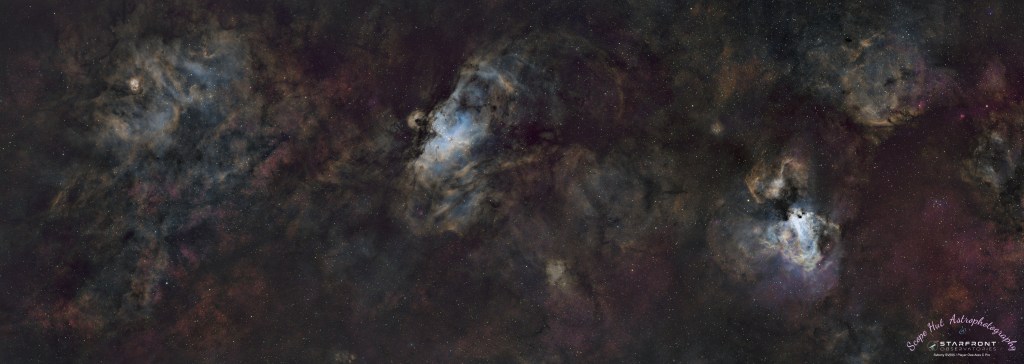
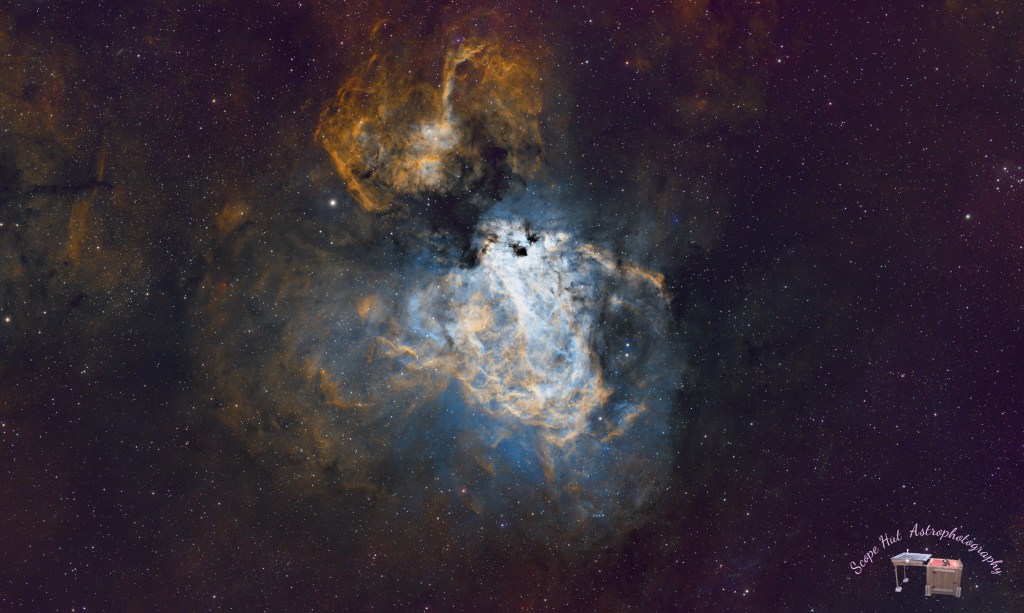
The M17 Nebula, most commonly known as the Omega Nebula or Swan Nebula, is a bright and extensively studied emission nebula (H II region) located in the constellation Sagittarius. It is a prominent site of massive star formation in the Milky Way.
Key Facts:
• Names: Omega Nebula, Swan Nebula, Horseshoe Nebula, Lobster Nebula, Checkmark Nebula (NGC 6618, Messier 17).
• Location: Sagittarius constellation, roughly 5,000–6,000 light-years from Earth.
• Size & Structure: The visible part of M17 is about 15 light-years across, set within a larger molecular cloud up to 40 light-years in diameter.
• Brightness: Apparent magnitude of 6.0, making it one of the brightest star-forming regions in the sky, visible through small telescopes or binoculars under dark conditions.
Star Formation:
• Hosts one of the youngest and most massive open clusters in the Milky Way, with an age of about 1 million years.
• The embedded cluster (NGC 6618) includes hundreds of stars, including at least 9 O-type stars and over 100 B-type stars, with over a thousand protostars in the outer regions.
• The powerful ultraviolet radiation and stellar winds from these hot, massive stars ionize the surrounding hydrogen, causing the nebula to glow and sculpting the nebula’s shape.
• The region has undergone multiple waves of star formation, continuing into the present day, with evidence of ongoing star formation observable in the molecular cloud.
Notable Features:
• The nebula’s distinctive visual appearance—a loop or swan’s neck and head—is responsible for its various names.
• Contains massive luminous blue variable and hypergiant stars, such as HD 168607 and HD 168625, which are expected to end as supernovae.
• Observational Highlights:
• Spectacular in both visible and infrared light. Infrared observations (like those from the Spitzer Space Telescope) reveal the hidden young stars embedded in dust and gas, and intricate structures sculpted by stellar winds.
• The brightest, most massive part of the cluster is shrouded and difficult to see in visible wavelengths, but easily revealed by infrared astronomy.
Historical Notes:
• Discovered in 1745 by Jean-Philippe Loys de Chéseaux and later cataloged by Charles Messier in 1764.
• Its Omega name derives from John Herschel’s impression in 1833 that it resembled the Greek letter Ω.
In Summary:
The Omega Nebula (M17) stands out as one of the most luminous, massive, and active star-forming regions in our galaxy, offering astronomers a nearby laboratory for studying the complex processes of stellar birth, evolution, and the shaping of interstellar clouds.
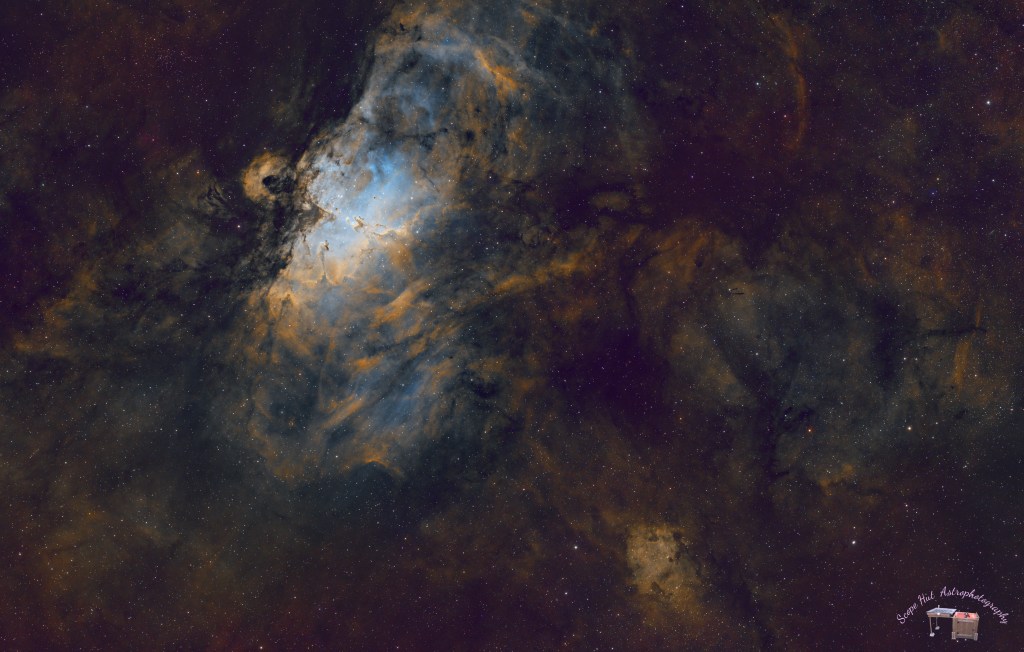
The M16 Nebula, widely known as the Eagle Nebula, is one of the most famous star-forming regions in our galaxy and is best distinguished by the iconic Pillars of Creation—vast columns of gas and dust made famous by the Hubble Space Telescope.
Essential Information:
• Type: Emission nebula with a young open star cluster
• Constellation: Serpens
• Alternate Names: Messier 16, M16, NGC 6611 (cluster), IC 4703 (nebula), Star Queen Nebula
• Distance from Earth: 5,700–7,000 light-years (latest measurements suggest about 5,700 light-years)
• Apparent Magnitude: 6.0–6.2, visible with small telescopes under dark skies
• Apparent Size: Roughly 70 x 55 light-years across; occupies about 30 arcminutes of the sky
• Cluster Details: Contains thousands of young stars, with the most massive (HD 168076) having about 80 times the mass of our Sun
• Pillars of Creation: These are about 4–5 light-years long and are small compared to the full nebula
• Cluster Age: Approx. 1–2 million years
Notable Features:
• Pillars of Creation: Towering columns within the nebula, these are active sites of star formation, where newborn stars are forming within and around the gas and dust. They are slowly eroding due to intense ultraviolet light from nearby, young massive stars.
• Other Structures: The nebula also contains several spires and smaller star-forming regions, such as the “Stellar Spire,” all illuminated and sculpted by the energy from new stars.
• Visibility: Best observed from June to September for mid-northern latitudes. The Eagle Nebula requires a telescope to see clearly, and longer exposure photography reveals its intricate details.
• Cluster and Nebula Catalogs: The star cluster is NGC 6611, and the nebula is IC 4703.
Cultural and Scientific Importance:
• First Discovery: By Jean-Philippe de Cheseaux in 1745–46.
• Imaging: The Pillars of Creation Hubble photograph (first taken in 1995, updated in 2014) is among the most influential astronomical images, illustrating dynamic star birth and nebular evolution.
Appearance and Name:
• Name Origin: The shape resembles an eagle with outstretched wings, leading to the popular name, while the “Star Queen Nebula” name refers to its pillar silhouette.
 ScopeHut Observatory
You must be logged in to post a comment.