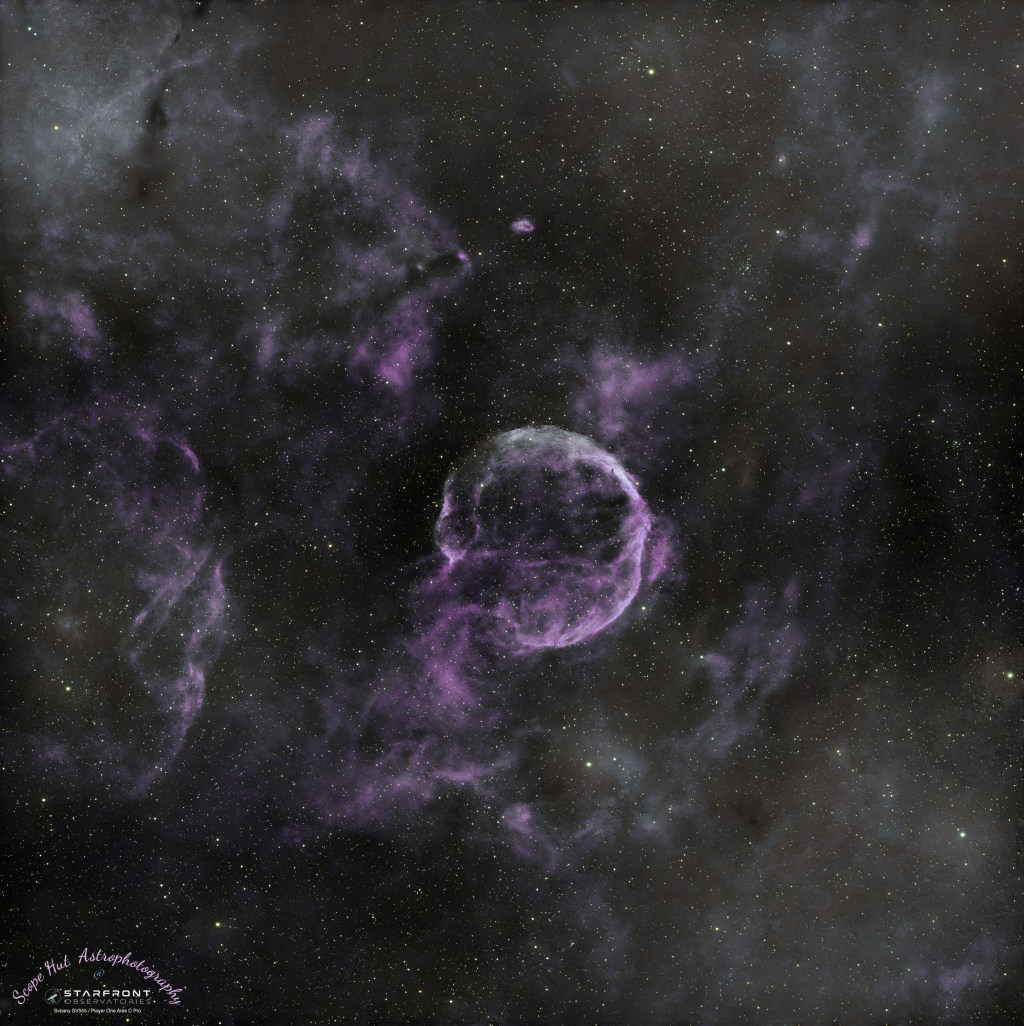
(also known as G116.9+00.1, Abell 85, and the Medulla Nebula)
CTB 1 is a supernova remnant located in the constellation Cassiopeia. Here are its most significant characteristics:
Discovery and Classification:
• Discovered as a radio source during a 1960 survey at 960 MHz.
• Initially misclassified as a planetary nebula (Abell 85) and HII region (LBN 576) before being confirmed as a supernova remnant in 1971.
Physical Appearance:
• Morphology: Mixed-morphology type—appears as a hollow shell in radio, with centrally concentrated X-rays. Its optical shell is nearly circular but displays a “breakout” or rupture to the north, corresponding to a breach in both optical and radio emission. This is likely related to interaction with a cavity in the surrounding hydrogen gas.
• Size and Apparent Diameter: Roughly 35 arcminutes across (about half the size of the full Moon as seen from Earth).
• Visibility: Extremely faint in visible light, requiring dozens of hours of narrowband imaging (Hα and OIII) for detailed observation.
Composition and Emission:
• Elemental Abundances: Notably rich in oxygen and neon, unusual for such an old remnant, and consistent with a progenitor mass of at least 13–15 solar masses. Iron is found in greater abundance in the southwest section, indicating asymmetric ejection during the explosion.
• Radiation: Emits in radio, optical (notably Hα and OIII), infrared, and X-ray bands. Infrared arcs at 60 and 100 μm coincide with the radio shell.
Stellar Remnant:
• The pulsar PSR J0002+6216 is believed to be the neutron star left from the supernova. It is moving away from the SNR at more than 1000 km/s, with a bow-shock wind nebula and a long “trail” pointing back toward the SNR’s center, supporting their physical link.
• The rapid movement likely results from the asymmetric nature of the explosion, imparting a “kick” to the pulsar.
Distance and Age:
• Distance: Most estimates place CTB 1 between 2,000 and 3,100 parsecs (6,500–10,100 light-years), but some studies suggest up to 4,300 ± 200 parsecs.
• Age: Estimated mostly at 10,000 years, though some sources suggest up to 16,700 years.
• Diameter: Approximately 15 parsecs (≈50 light-years) in radius, so about 100 light-years across if at the larger distance estimate.
Historical and Catalog Notes:
• Its misidentification as a planetary nebula in the Abell catalog (Abell 85) and as an HII region (LBN 576) underscores the challenge of classifying faint or ambiguous deep-sky objects.
Observation:
• Its setup for amateur astronomy is demanding; imaging typically requires over 50 hours of integration in narrowband to resolve the delicate filaments and shell structure.
• It is best observed from northern latitudes, being circumpolar and highest in the sky during autumn and winter months.
CTB 1 exemplifies the complexity and variety of supernova remnants, providing a unique target for both professional and experienced amateur astronomers interested in cosmic supernova events and their aftermath.
 ScopeHut Observatory