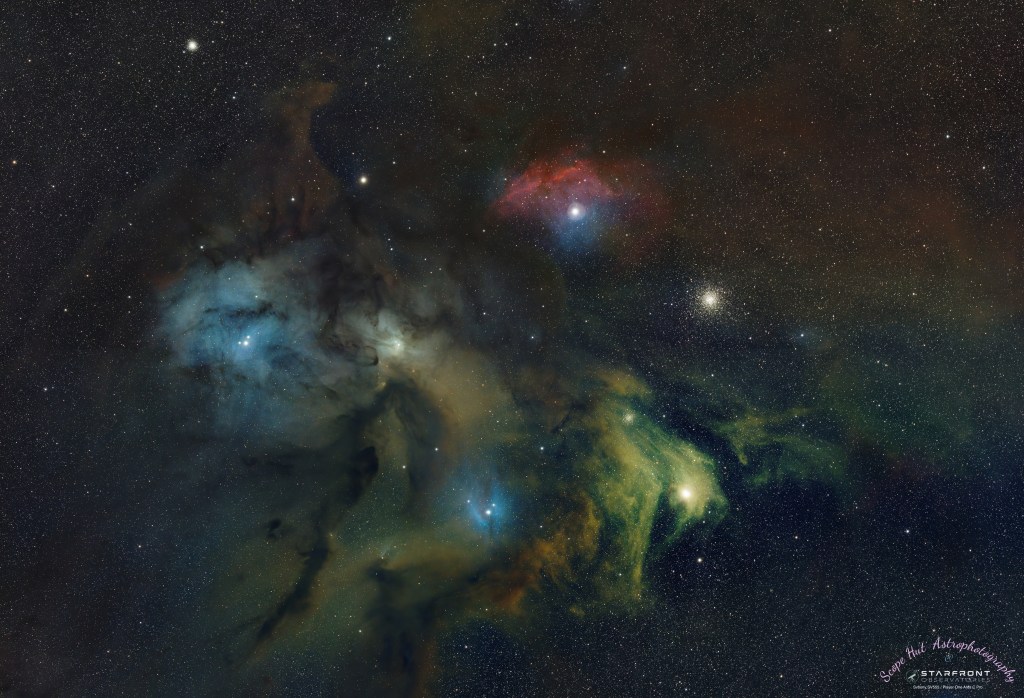
This image captures the Rho Ophiuchi cloud complex, one of the most colorful and visually striking star-forming regions in the night sky. It is located about 390–460 light-years from Earth in the constellation Ophiuchus, making it the closest stellar nursery to our solar system.
Key Features Visible in the Image
• Rho Ophiuchi Nebula: The central blue and gold clouds are illuminated by the Rho Ophiuchi star system, which is surrounded by reflection, emission, and dark nebulae. These nebulae interact dynamically, creating a vivid tapestry of colors and shapes.
• Antares: The bright, fiery yellow-orange star at the lower right is Antares, the brightest star in Scorpius. The yellowish glow around it is due to the emission nebula IC 4606.
• Messier 4 (M4): Just above Antares is the globular cluster Messier 4, a dense collection of about 100,000 stars roughly 5,500 light-years away.
• NGC 6144: Another globular cluster, smaller and dimmer than M4, appears nearby in the upper left portion of the image.
• Dark Nebulae: The dark, river-like streaks running through the region are thick clouds of interstellar dust, including Barnard 45 and Barnard 42, which obscure the background stars and separate different nebulae in the complex.
• Star Formation: The blue and red hues indicate regions where young stars are forming. The blue is from reflection nebulae, where dust reflects starlight, while the red regions are emission nebulae, glowing from ionized hydrogen.
Scientific Significance
• Active Star Formation: The Rho Ophiuchi complex is a stellar nursery, with dense clouds giving birth to new stars and planetary systems. Observations have revealed hundreds of young stellar objects, including protostars and T Tauri stars, making it a key region for studying early stellar evolution.
• Proximity: Its relative closeness to Earth allows astronomers to study star and planet formation in detail, including circumstellar disks and jets from young stars.
• Cosmic Neighborhood: The image brings together objects at vastly different distances: Rho Ophiuchi (~390 light-years), Antares (~550 light-years), and Messier 4 (~5,500 light-years), all appearing in a single, breathtaking frame.
Visual Description
The image is renowned for its vibrant colors and intricate structures:
• Blues and golds from reflection and emission nebulae.
• Dark, wispy filaments of dust weaving through the region.
• Bright stars and clusters embedded within glowing clouds.
• A sense of depth, as objects at different distances overlap visually.
In summary:
This is a deep-sky portrait of the Rho Ophiuchi cloud complex, featuring a rich interplay of nebulae, young stars, dark dust clouds, and prominent neighbors like Antares and Messier 4. It is both a stunning visual spectacle and a vital region for understanding how stars and planetary systems are born
Rho Ophiuchi cloud complex
 ScopeHut Observatory