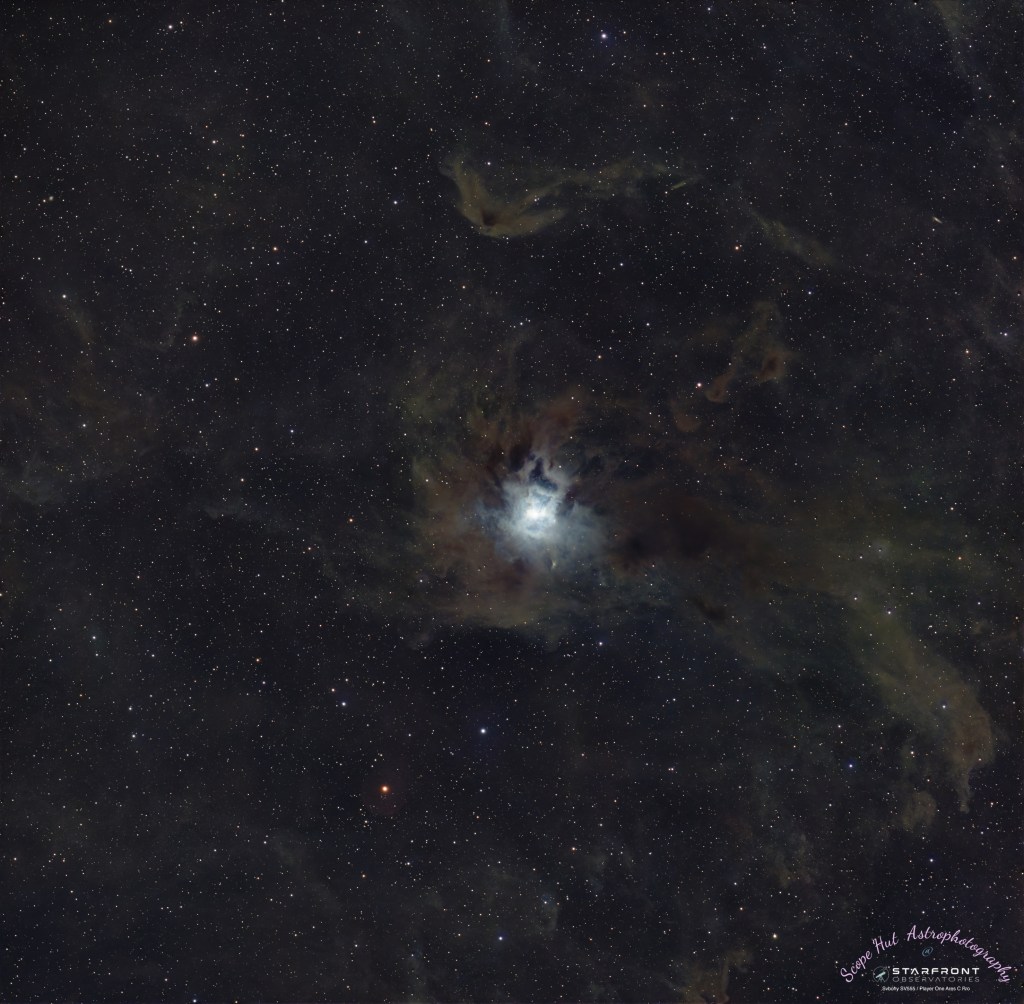
This image features the Iris Nebula (NGC 7023), a striking reflection nebula located about 1,300 light-years away in the constellation Cepheus. The nebula is renowned for its flower-like appearance, with a luminous blue core surrounded by wispy, dark clouds of interstellar dust that extend outward, resembling the petals of an iris flower.
Key Features
• Central Blue Glow: The bright, bluish region at the center is caused by a young, hot star (HD 200775) whose light is scattered by tiny dust particles in the nebula. This scattering is similar to the way Earth’s sky appears blue, giving the nebula its vivid hue.
• Dark Dust Lanes: Surrounding the glowing center are dense clouds of dust, which both absorb and scatter light. These dark filaments and patches create dramatic contrasts and define the “petal” structure of the nebula.
• Hints of Red: In some regions, faint reddish tones are visible. These are caused by photoluminescence—certain dust grains absorb ultraviolet light from the central star and re-emit it as visible red light.
• Size: The nebula spans about 6 light-years across, with its intricate structure and colors making it a favorite subject for astrophotographers and astronomers alike.
Scientific Significance
• Reflection Nebula: Unlike emission nebulae, which glow from their own ionized gases, reflection nebulae like the Iris Nebula shine by reflecting the light of nearby stars. The Iris Nebula is a textbook example of this phenomenon.
• Star Formation: The nebula contains complex carbon molecules (polycyclic aromatic hydrocarbons, or PAHs) that are essential ingredients for star formation, offering astronomers insights into the processes that lead to the birth of new stars.
Visual Impact
The image captures the Iris Nebula as a luminous, ethereal flower blossoming in the darkness of space, surrounded by a rich tapestry of stars and faint interstellar dust. Its blend of blue, brown, and subtle red hues, along with the intricate interplay of light and shadow, highlights both the beauty and complexity of the cosmos.
Iris Nebula (NGC 7023)
 ScopeHut Observatory