NGC 7000
North American nebula
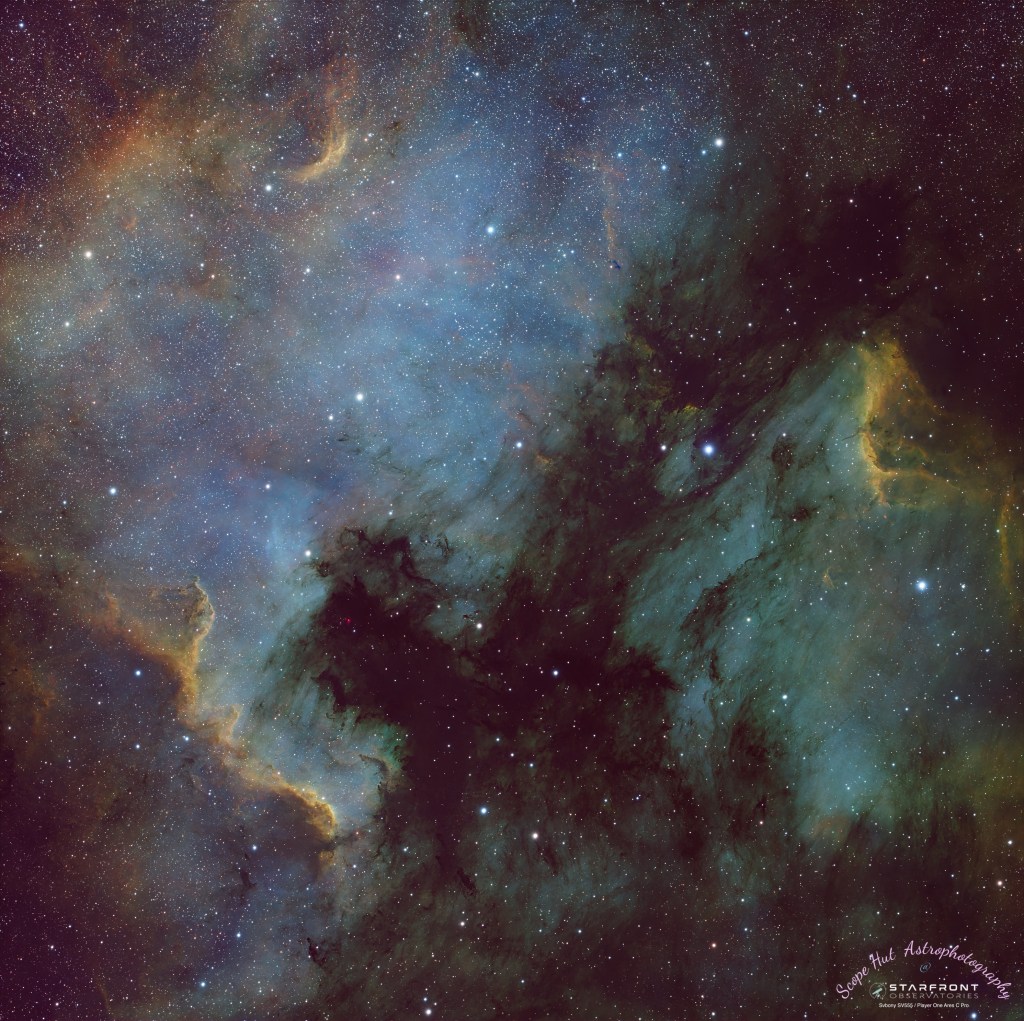
The North American Nebula (NGC 7000, Caldwell 20, Sharpless 117) is a large emission nebula located in the constellation Cygnus, near the bright star Deneb[1][2][3]. It is named for its distinctive shape, which closely resembles the continent of North America, complete with a Gulf of Mexico-like feature[1][3].
Key Facts
- Type: Emission nebula (H II region)
- Constellation: Cygnus
- Distance from Earth: Estimates vary, but most sources place it between 1,500 and 2,590 light-years away. Commonly cited values include 1,600–1,800 light-years, but some recent measurements suggest up to 2,590 light-years[1][2][3].
- Apparent Size: About 120 × 100 arcminutes—more than ten times the area of the full moon[1][3][4].
- Physical Size: Roughly 90–100 light-years across[5][1][3].
- Apparent Magnitude: Approximately 4 to 5[1][2][3].
- Mass: About 4,000 solar masses[5].
- Discovery: First observed by William Herschel in 1786; named by Max Wolf in 1890 after its resemblance to the continent[1][2][3].
- Ionizing Star: The nebula is illuminated by hot, massive stars, primarily the binary star HD 199579 (Miro’s Diamond), not Deneb[3][4].
- Associated Features: Shares a cloud complex with the Pelican Nebula (IC 5070), separated by a dark band of dust (L935)[1][3][4].
- Best Viewing: Visible from the northern hemisphere during summer and early autumn. Under ideal dark skies, it can be seen with the naked eye as a faint glow, but binoculars or a telescope will reveal more detail[2][6][4].
Notable Regions
- Cygnus Wall: The brightest region, resembling Mexico and Central America, is a site of active star formation[3].
- Embedded Clusters: The open star clusters Collinder 428 and NGC 6997 appear within the nebula but are not physically associated[3].
Summary Table
| Feature | Value/Description |
| Constellation | Cygnus |
| Distance | 1,500–2,590 light-years |
| Apparent Size | 120 × 100 arcminutes |
| Physical Size | ~90–100 light-years |
| Apparent Magnitude | 4–5 |
| Discovery | William Herschel (1786) |
| Ionizing Star | HD 199579 (Miro’s Diamond) |
| Associated Nebula | Pelican Nebula (IC 5070) |
| Notable Region | Cygnus Wall |
The North American Nebula is a favorite target for astrophotographers and observers due to its large size and striking shape[6][7][4].
- https://en.wikipedia.org/wiki/North_America_Nebula
- https://science.nasa.gov/mission/hubble/science/explore-the-night-sky/hubble-caldwell-catalog/caldwell-20/
- https://theplanets.org/nebula-facts/north-american-nebula/
- https://www.astronomy.com/observing/101-must-see-cosmic-objects-the-north-america-nebula/
- https://www.britannica.com/place/North-American-Nebula
- https://astrobackyard.com/north-america-nebula/
 ScopeHut Observatory