Over the weekend, I transported a telescope to a remote observatory in the dark, pristine skies of Texas, fulfilling a goal I had been pursuing for about a year. The move was motivated by the opportunity to utilize a wide field scope, which offers expansive views of the sky, ideal for deep-sky imaging. Interestingly, during this time of year, only smaller targets like galaxies are visible for most of the night, making this scope a perfect choice for a gradual introduction to remote astrophotography and learning the necessary skills
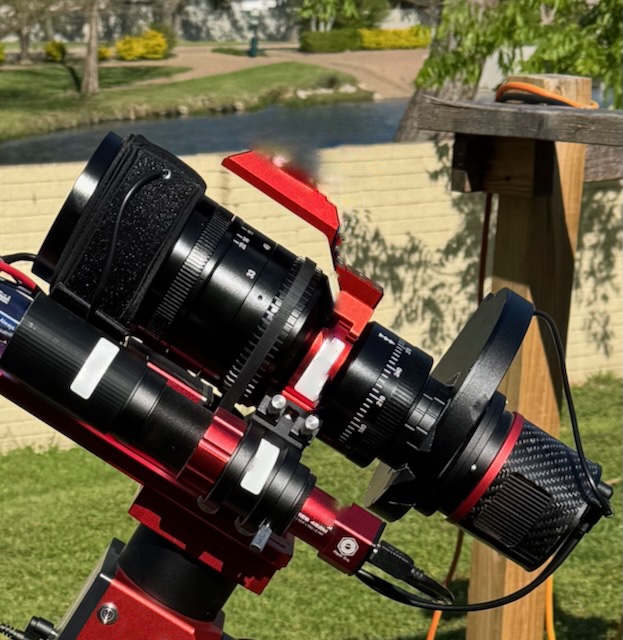
That was Saturday the 12th. When Tuesday rolled around, I received an email that they had my scope installed and it was ready to go. I could not believe it was all happening. As I starting looking for a image to get first light on, I tested everything to make sure I was ready. Then came the time to issue the sequence to begin a new journey in astrophotography. I choose a target that I had imaged from my back yard for a total of about 40 hours. I was very happy with the image and considered it one of my best. The Rosette Nebula.
The Rosette Nebula is a vast emission nebula and active star-forming region located about 5,000 to 5,200 light-years away in the constellation Monoceros, the Unicorn. It spans roughly 100 to 130 light-years across, making it much larger than the more famous Orion Nebula, though it appears dimmer due to its greater distance.
At the center of the Rosette Nebula lies the open star cluster NGC 2244, whose young, hot O- and B-type stars formed from the nebula’s material within the last 5 million years. These massive stars emit intense ultraviolet radiation and stellar winds that ionize the surrounding hydrogen gas, causing the nebula to glow predominantly in red hues. The stellar winds also carve out a central cavity and shape dark dust filaments called “elephant trunks” that extend inward.
The nebula is an H II region, meaning it is a cloud of ionized hydrogen gas energized by the radiation from its central stars. It is a stellar nursery containing various young stellar objects such as Herbig-Haro objects, T Tauri stars, and protostars. Over millions of years, the nebula’s gas will disperse due to the radiation pressure, leaving behind the central star cluster
Enough of the details. As I sat there waiting for the first 5 minute image to come in, I was nervous. Did I make the right decision to send the WF scope or should I have sent the best rig I have? Then the screen came to life and I saw more color and detail in a single 5m image than in hour of images from my backyard. Below is the total of 1 hour and 10 minutes. What you see below is better than my 40 hours Rosette that I had considered my best image. Going remote was worth the trip.
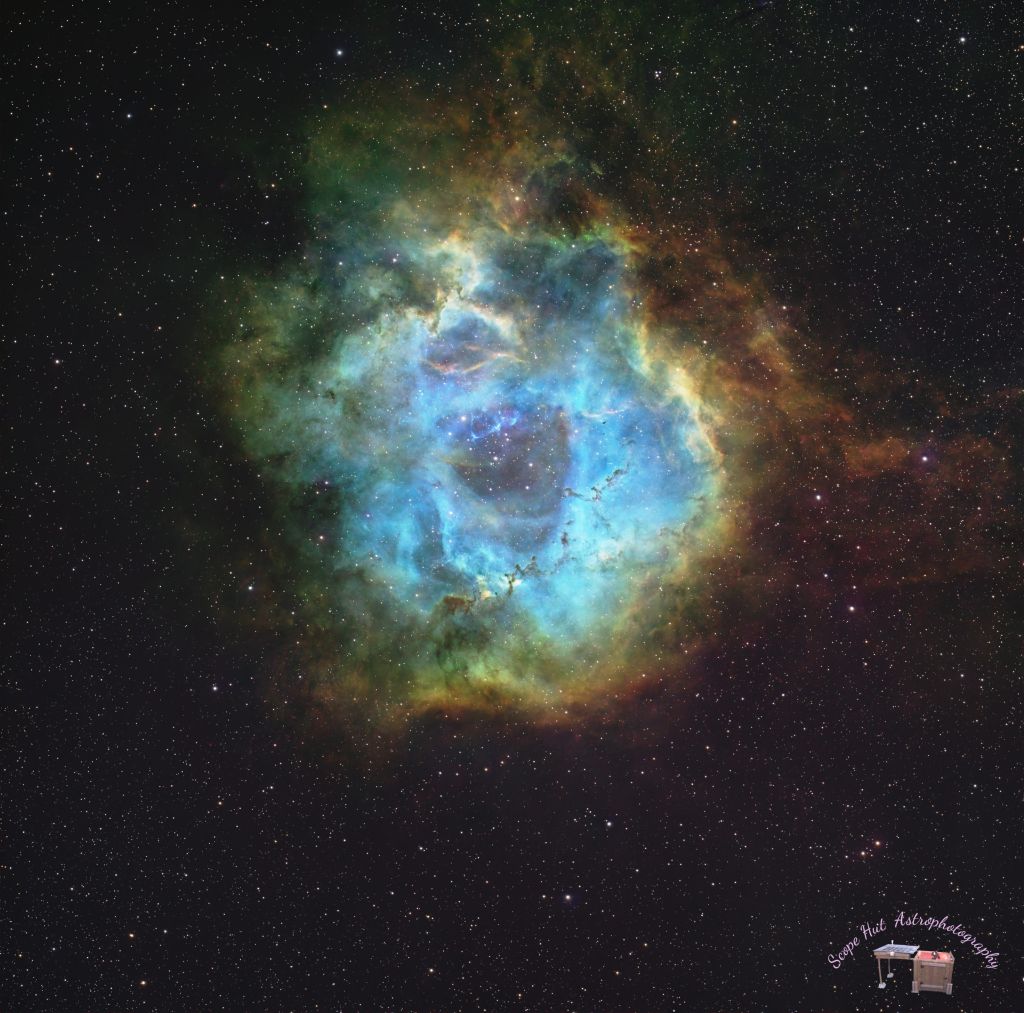
Rosette Nebula, 1 hour and 10 minutes SHO with RGB stars from Star Front Remote Observatory.
 ScopeHut Observatory
You must be logged in to post a comment.